

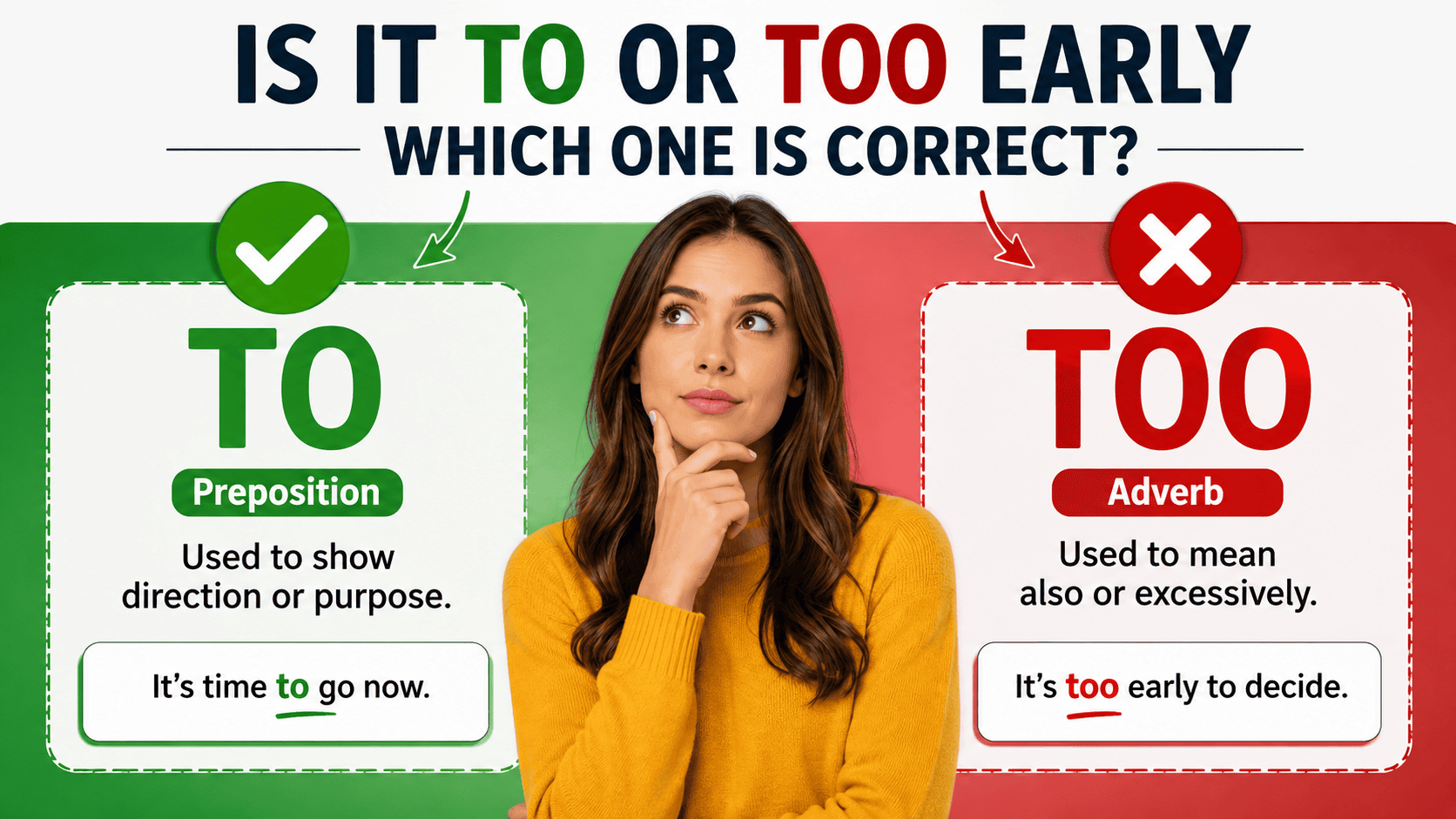
If you’ve ever typed “it’s to early” and then paused, wondering if that looks right, you’re not alone. This mix-up is one of the most common spelling slips in English, and it happens because “to” and “too” sound exactly the same when spoken.
The correct phrase is too early, and by the end of this guide, you’ll know exactly why, how to use it correctly, and how to stop making this mistake for good.
What Do “To” and “Too” Actually Mean?
Before we settle the “to early or too early” debate, it helps to understand what each word actually does in a sentence. They may sound identical, but their jobs are completely different.
What “To” Means and How It Works
“To” is a preposition or part of an infinitive verb. It usually points toward a direction, a destination, or an action.
- I’m going to the store.
- She wants to sleep.
- We drove to Chicago.
Notice that “to” almost always connects to a verb or a place. It never means “excessively” or “also.”
What “Too” Means and How It Works
“Too” is an adverb, and it means “excessively,” “more than needed,” or “also.”
- The soup is too hot.
- He talks too much.
- I want to come too.
If you can replace the word with “also” or “excessively” and the sentence still makes sense, “too” is the correct choice.
To vs Too vs Two — Why These Three Words Confuse Everyone
English has a third homophone in this mix: “two,” the number. All three words sound identical, but they serve completely different purposes.
| Word | Function | Example |
| To | Direction / infinitive verb | Going to work |
| Too | Excess / also | Too tired, me too |
| Two | Number | Two coffees |
Since your ears can’t tell these apart in speech, your brain has to rely on grammar rules, not sound, to choose the right one in writing.
Is It “To Early” or “Too Early”?
The correct phrase is always too early. “To early” is not standard English and is considered a spelling error, no matter how casual the context.
Why “Too Early” Is Always Correct
“Too” works as an adverb here, modifying the adjective “early.” It shows that something happened before the right or expected time.
- We arrived too early for the meeting.
- It’s too early to tell.
- The alarm went off too early.
In each case, “too” adds the meaning of “earlier than necessary.”
Why “To Early” Is Always Wrong
“To” needs a verb or a noun of direction to make sense. “Early” is neither, so pairing “to” with “early” leaves the sentence without a grammatical function. That’s why “to early” simply doesn’t work, no matter how the sentence is structured.
“Too Early” Meaning Explained in Simple Words
In plain terms, “too early” means something happened before it should have, before the ideal time, or sooner than expected. It’s not about being wrong exactly, it’s about timing being off.
How to Use “Too Early” in a Sentence
Seeing “too early” used across different settings makes it easier to remember correctly.
In Everyday Conversation
- It’s too early for coffee, isn’t it?
- The kids woke up too early today.
- We left too early and missed the traffic rush.
In Professional and Workplace Writing
- It’s too early to finalize the budget numbers.
- The team submitted the report too early, before the data was verified.
- Please don’t schedule the call too early; most clients aren’t available before 9 AM.
In Academic and Formal Writing
- Researchers noted it was too early to draw definitive conclusions from the trial data.
- The proposal was submitted too early in the review cycle to be considered.
In Texting and Social Media
- lol it’s too early for this 😩
- too early to be up, but here we are
Why People Type “To Early” by Mistake
This isn’t really about not knowing grammar. It’s mostly about speed and habit.
- Same pronunciation – “to” and “too” sound identical, so your ear gives no clue.
- Fast typing – muscle memory often defaults to the shorter, more common word “to.”
- Rare double letters – “too” has two O’s, which some writers simply forget to type.
- Lack of proofreading – quick messages and social posts rarely get reviewed before sending.
Autocorrect and Spell-Check Don’t Catch This Error
Here’s the tricky part: both “to” and “too” are real, correctly spelled words. Spell-checkers only flag misspellings, not wrong-word choices. So “to early” sails right past autocorrect because “to” isn’t a typo, it’s just the wrong word for that sentence.
To Early vs Too Early — Quick Comparison Table
| Phrase | Correct? | Why |
| Too early | ✅ Yes | “Too” correctly modifies “early” to show excess timing |
| To early | ❌ No | “To” has no grammatical role before an adjective like “early” |
Easy Tricks to Never Confuse “To” and “Too” Again
Once you have a memory trick, this mistake becomes nearly impossible to make.
The Extra “O” Trick
“Too” has an extra “O,” just like it adds an extra amount of meaning (excess, also). Think: more O’s, more meaning.
The Replacement Test
Try swapping the word with “also” or “very.” If the sentence still makes sense, use “too.”
- It’s ___ early. → It’s very early. ✅ Use “too.”
The “Very” Substitution Trick
Similarly, if you can insert “very” before the adjective and it still reads naturally, “too” is almost certainly correct, since both words intensify meaning.
Other Word Pairs People Often Confuse With To and Too
- Their / There / They’re
- Your / You’re
- Its / It’s
- Then / Than
These pairs trip people up for the same reason: they sound alike but function differently.
Does This Mistake Hurt Your Credibility in Writing?
Yes, especially in professional or academic contexts. A single “to early” instead of “too early” might seem minor, but repeated small grammar errors can make writing look rushed or careless, whether it’s a work email, a resume, or a blog post. Clean grammar builds trust with your reader.
Frequently Asked Questions
Is it “too early” or “to early”?
It’s always “too early.” “To early” is grammatically incorrect.
Why do people write “to early” instead of “too early”?
Because “to” and “too” sound identical when spoken, and autocorrect doesn’t catch the wrong-word error.
Is “too early” formal enough for professional writing?
Yes, “too early” is standard, correct English and appropriate for any formal or professional context.
What’s an easy way to remember the difference?
Try replacing the word with “also” or “very.” If it still makes sense, use “too.”
Can “to early” ever be correct?
No, “to early” is not standard or accepted in any context of English grammar.
Conclusion
The rule is simple: it’s always too early, never “to early.” “Too” adds the meaning of excess or “more than needed,” which is exactly what you’re expressing when something happens before the right time.
Keep the Extra “O” Trick and the Replacement Test in mind, and you’ll never second-guess this one again, whether you’re texting a friend, writing a work email, or drafting a formal report.